
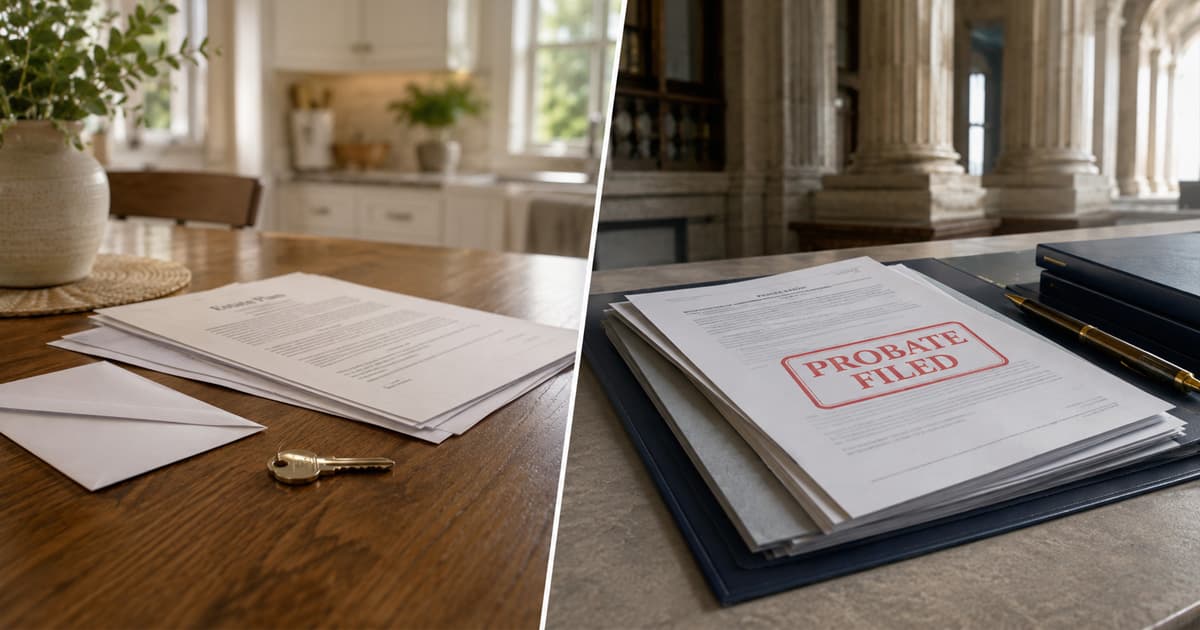
Most investors hear "probate leads" and think of a court-filed probate case — the formal estate proceeding with a petition, a personal representative, a notice to creditors. But Florida pre-probate leads — the public records that appear in the days and weeks before a probate case is filed — are quietly some of the highest-intent estate signals in the state. By the time a probate case appears on the docket, the death often happened months earlier; the family has already started talking to a Realtor, and your postcard is competing with everyone else's.
This guide compares pre-probate and Florida probate leads side by side: what each public-record signal reveals, when each one appears, and which one a Florida investor should be working first.
The pre-probate vs probate landscape in Florida
Both signals come from public Florida court records, but they sit at different stages of the estate timeline.
- Pre-probate signals appear within days or weeks of death. They include obituaries, the deposited original will (Florida Statute 732.901), and the Notice of Trust filed by the trustee when the decedent's property was held in a revocable trust (Florida Statute 736.05055).
- Court-filed probate is the formal court case under Florida Statutes Chapter 733 (Formal Administration) or Chapter 735 (Summary Administration). It carries a public docket, an appointed personal representative, and a creditor-claim process.
| Dimension | Pre-probate signals | Court-filed probate |
|---|---|---|
| Source | Obituary, deposited will (F.S. 732.901), Notice of Trust (F.S. 736.05055) | Petition for administration under F.S. Ch. 733 or Ch. 735 |
| Timing relative to death | Days to weeks | Often months — and some estates never open a probate case at all |
| Who the law identifies | Surviving family (obituary), named beneficiaries and executor (deposited will), successor trustee (Notice of Trust) | Court-appointed personal representative, estate attorney, and any caveators |
| Who can sign on the property | Nobody yet, in most cases | Personal representative, within the limits of the order of administration |
| Competition | Lower — most national vendors don't surface obituaries, deposited wills, or trust notices at the Florida county level | Higher — the probate index is the standard lead list every probate vendor sells |
| Best use | Soft-touch, first-mover outreach to family before decisions are made | Direct, transaction-ready offer to the personal representative |
The three pre-probate signals — and what each tells you
1. Obituaries. Often the earliest public indication that the owner of a property has died. The obituary names the decedent, the date of death, and surviving family — names that, with parcel data alongside, identify the property at the center of the estate. Obituaries do not grant anyone authority to sell, but they are the moment the conversation can begin.
2. Deposited will (F.S. 732.901). The custodian of an original will must deposit it with the clerk of the court having venue of the estate within 10 days after receiving information that the testator has died. The Florida will deposition sits on the public docket, even when no probate case has been opened yet. The deposited will reveals the named personal representative (executor), the beneficiaries, and any specific real-estate devises — sometimes months before any formal probate filing appears.
3. Notice of Trust (F.S. 736.05055). When the decedent's property was held in a revocable trust, the trustee files a Notice of Trust with the court of the county of the settlor's domicile (and with the court having jurisdiction of the settlor's estate, if any). The notice lists the settlor's name, the settlor's date of death, the title and date of the trust, and the name and address of the trustee. The Notice of Trust is structurally different from the other two signals: most trust-held estates never open a probate case at all, so the Notice of Trust may be the only court record that a real-estate transfer is in motion.
What changes once a court-filed probate case opens
Once a petition for administration is filed under Chapter 733 (Formal Administration) or Chapter 735 (Summary Administration), three things change at once:
- A personal representative is appointed. The PR has court authority to inventory, manage, and ultimately sell estate property, subject to the order of administration.
- The estate is on the clock. Notice to creditors, the three-month claim window, accountings, and inventory deadlines all start running.
- The lead becomes obvious. Every probate vendor pulls the docket. The PR's mailbox fills up.
This is also where Florida's summary administration path matters for investors. Summary administration is the faster, lower-cost track for smaller estates and for any estate where the decedent has been dead for more than two years. The asset threshold is currently $75,000 of non-exempt probate assets, but Florida's new $150,000 summary administration threshold (CS/SB 1500) doubles the cap to $150,000 for decedents who die on or after July 1, 2026 — meaning a meaningfully larger share of estates will qualify for the streamlined path starting just weeks from now.
How court-filed probate volume breaks down in Florida
The court-filed probate signal is large in absolute terms. Florida courts recorded 67,808 probate filings across the 67 counties in fiscal year 2024-25 (Florida Office of the State Courts Administrator, FY 2024-25 Statistical Reference Guide, Chapter 6, page 6-2). The four counties PocketLeads currently covers — Collier, Lee, Sarasota, and Pinellas — produced roughly one in every six of those filings:
| County | Probate filings (FY 2024-25) |
|---|---|
| Collier | 1,702 |
| Lee | 3,467 |
| Sarasota | 2,311 |
| Pinellas | 3,934 |
| 4-county total | 11,414 |
Court-filed probate is not the whole estate-signal picture, though. Many estates skip probate entirely — when the decedent's real estate was held in a revocable trust, the transfer is handled through the trust documents and the Notice of Trust filing, not through a probate case. Court statistics do not separately publish a count of Notices of Trust, and the obituary and deposited-will volume that drives the pre-probate stage does not appear in court filing tables at all. An investor who works only the probate docket sees a subset of estate-property activity in Florida, not the full picture — which is the structural reason serious operators pair the two stages instead of choosing between them.
Which signal should an investor work first?
If you can only run one campaign, start with court-filed probate. The personal representative has authority to sign, the timeline is defined, and the docket refreshes weekly. You will close deals faster while you learn the workflow. The Florida probate process guide and the Florida probate direct-mail playbook cover how to sequence touches around the statutory clock — read those before your first mailing.
If you can run both — which the better-funded operators do — work pre-probate as the early-warning layer and court-filed probate as the conversion layer. The pre-probate touches earn a relationship with the family or trustee before anyone else is in the conversation; the court-filed touches close deals once a PR is in place. The trap to avoid is treating pre-probate as an offer stage. Until a PR is appointed (or, in trust cases, the successor trustee accepts), nobody has authority to sign. A pre-probate mailer that asks for a price or a closing date in the first week will at best be ignored. Soft-touch first; binding offer later. Most serious wholesalers running both stages keep the pre-probate copy at the level of "we buy estate properties when families are ready" and reserve transaction language for the court-filed window — that's the discipline.
Frequently asked questions
What is the difference between Florida pre-probate leads and probate leads?
Pre-probate leads are based on public records that appear before a probate case is filed — obituaries, original wills deposited with the clerk under F.S. 732.901, and Notices of Trust filed under F.S. 736.05055. Court-filed probate leads come from the formal case under Chapter 733 or Chapter 735, after a petition for administration has been filed. Pre-probate is earlier and less competitive but carries no signer authority; court-filed probate is later but identifies a personal representative who can transact.
Does every Florida death produce a probate case?
No. If the decedent's real estate was titled in a revocable trust, the property typically transfers without a probate case — and the only public signal may be the Notice of Trust filed under F.S. 736.05055. Estates with no probate assets, or with only assets that pass by beneficiary designation or joint ownership with survivorship, also won't appear in the probate index.
How quickly does a Florida will become public?
Under F.S. 732.901, the custodian of the original will must deposit it with the clerk of the court having venue of the estate within 10 days after receiving information that the testator has died. The deposited will then sits in the court file, even if no probate case has been opened. The Florida will deposition is what makes the named executor and beneficiaries identifiable before formal probate begins.
Can I make an offer on the property during the pre-probate window?
You can express interest, but there is usually no one with legal authority to sign a binding contract until a personal representative is appointed in a probate case — or, for trust-held property, until the successor trustee accepts the role. Pre-probate is a relationship stage; the binding transaction happens once the appropriate authority is in place.
See Florida pre-probate leads and probate side by side in PocketLeads
PocketLeads covers both stages of the Florida estate signal inside probate leads — pre-probate from obituaries, deposited wills, and Notice of Trust filings; and court-filed probate cases from the four active Florida counties (Collier, Lee, Sarasota, Pinellas) — with more counties on the way. Every record tracks the property through every stage: surviving family, deposited will, personal representative when the case opens, and parcel and equity data alongside. Start a free PocketLeads trial and see the same dataset the working investors use.